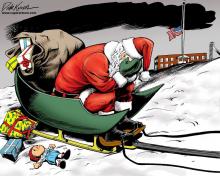
Mary Matalin has no problem with a man slapping a woman around
In Mary's defense, it was a "professional colleague" who probably deserved it. How does Skeletor put up the Wicked Witch. What a piece of work.
Anyone who has ever been in the Defcon One pressure cooker of a national campaign knows that "mistakes are made," feelings are hurt, tempers are short, bitching is background noise. There is no such thing as Emily Post for political campaigns. Except for maybe Poppy Bush, good manners do not exist on any campaign planet. For good reason: They take time.
Time is the most valuable commodity on a campaign and you just can't waste it thinking about how to choose your words carefully or get your job done more diplomatically. If someone isn't in tears every day, that day wasn't all it could be advancing the campaign. I once witnessed an experienced (big) man slap a professional female colleague across the face over an ad buy... and no one thought anything of it, starting with the woman. In fact, she would have been insulted if anyone told her she should have been insulted.
Reagan Didn't End the Cold War -- Leftist Intellectuals Did
By Stephen Zunes, AlterNet Posted on November 20, 2009, Printed on November 21, 2009
The 20th anniversary of the 1989 Velvet Revolution that overthrew the Communist regime in Czechoslovakia was one of the most impressive civil insurrections in history. It was not the military might of NATO, but the power of nonviolent action by ordinary citizens which brought down the system. The popular uprising against the repressive system that had ruled their country for much of the previous four decades -- along with comparable movements, which came to the fore that year in Poland, Hungary and East Germany -- marks a great triumph of the human spirit.
These movements were largely led by democratic socialists who mobilized workers, church people, intellectuals, and others to face down the tanks with their bare hands. Yet here in the United States, we are told that it was a result of President Reagan's militarism and the supposed inherent superiority of capitalism. It is this false narrative that has played such a major role in shifting discourse to the right in subsequent decades and has been used to discredit those struggling for a more just and egalitarian economic system and a more sane and less imperialistic foreign policy.
President Reagan's verbal support for democracy had little credibility in many of these countries. For example, while he denounced Poland's martial law regime, he was a strong supporter of the more repressive martial law regime then in power in NATO ally Turkey and scores of other dictatorships. In challenging left-wing governments in the Third World, Reagan gave little credence to nonviolent action and instead backed insurgents with ties to U.S.-backed dictatorships and -- in the case of Afghanistan -- even Islamic fundamentalists.
Fortunately, 219 Democrats and 1 Republican, Cao of Louisianna, voted Yes and passed this historic piece of legislation. I suspect it will pass the Senate and then Congressman Baird will see the light and vote for the Conference Bill.
"[People] are fed up -- frustrated and fed up and angry about the way in which our government does not work, about the way in which we come down here and get into a lot of political games and seem to -- partisan tugs of war and forget why we're here, which is to serve the American people. And I think the filibuster has become not only in reality an obstacle to accomplishment here, but it also a symbol of a lot that ails Washington today."
"The whole process of individual senators being able to hold up legislation, which in a sense is an extension of the filibuster because the hold has been understood in one way to be a threat to filibuster -- it's just unfair."
Democrats Risk Electoral Disaster If They Drop the Public Option
By Robert Parry, Consortium News.
Indeed, if the Democrats abandon the public option for the sake of passing a bill like the one that came out of the Senate Finance Committee, they may be courting electoral disaster once voters grasp that they will have to wait years for the law to be implemented and then that it could lead to higher costs for much the same unpopular private insurance plans.
The public option offers the only means for a reform to be quickly implemented and to demonstrate a beneficial effect for the people by 2010 and 2012. It has the potential for reducing costs, especially for small businesses and individuals who are now being soaked by private insurers or denied coverage.
After assessing the five pieces of legislation that have cleared different committees of Congress, the non-partisan Congressional Budget Office found that the nation would get the most savings on health-care costs from a public option tied to Medicare rates. Such a version, which is included in two of the House bills, would save an estimated $110 billion over 10 years.
If the Democrats bend to the demands of the industry and the Republicans, Obama and congressional Democrats could find themselves in several years explaining how they enacted “reforms” that bully moderate-income Americans into buying over-priced health insurance, fatten the industry’s profits and fail to achieve any meaningful cost controls.
Such an outcome could be catastrophic to the Democratic Party’s future and to the concept of progressive governance. Yet, some members of the Senate Democratic leadership appear to heading in that direction, wanting to portray pushing through some bill – even one without a public option – as a victory.
Former Kansas Sen. Bob Dole says "there will be a signing ceremony" for a health care reform bill either late this year or early next.
But the former presidential candidate says he isn't sure what the bill will say.
Dole, 86, spoke with reporters after an hour-long speech at a health care reform summit sponsored by Blue Cross and Blue Shield of Kansas City.
And he repeatedly blamed "partisanship" for the failure to produce a bill so far.
"Sometimes people fight you just to fight you," he said. "They don't want Reagan to get it, they don't want Obama to get it, so we've got to kill it...
"Health care is one of those things...Now we've got to do something." More...
Sen. Max Baucus earns his healthcare industry contributions
Joan Walsh Salon.com
On “The Ed Show” Monday night I said Montana Sen. Max Baucus had to decide whether he represented Montana or the insurance industry. Tuesday he made his choice, voting against both public option amendments to the health care reform bill in the Senate Finance Committee.
All the Democrats who voted against the public option should be ashamed, but Baucus most of all. The Senate Finance Committee chair’s reasoning was bizarre. According to Salon’s Mike Madden, whose coverage today was terrific, Baucus admitted “the public option would help hold insurance companies' feet to the fire,” then added, “But my first job is to get this bill across the finish line."
No, Sen. Baucus. Your first job is voting for what will work to extend health care to more Americans and reduce costs. (And Harry Reid, you might want to have a little talk with your boy from Montana, since it’s my understanding the Senate Majority Leader is in charge of getting the bill across the finish line.)
So let’s get this straight: Baucus admits the public option would “hold insurance companies’ feet to the fire,” but he voted against it? Is there any clearer evidence that Baucus is in the pocket of the health insurance industry? Between 2003 and 2008, according to the Washington Post, Baucus took $3 million from the health and insurance sectors, 20 percent of his total contributions. And he collected half of that money in just the last two years, as the committee he chaired began holding hearings on health care reform.